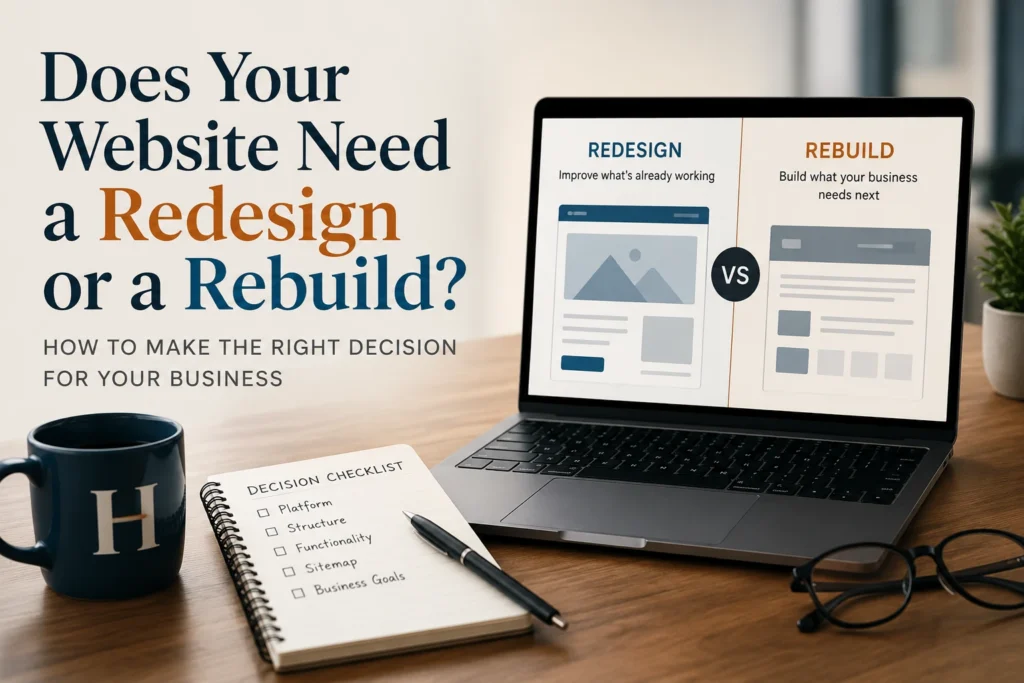
Does Your Website Need a Redesign or a Rebuild?
A website redesign and a website rebuild aren’t the same project.
When people compare a website redesign vs rebuild, the difference can sound simple. Keep the existing website and improve it, or throw it away and start over.
That’s not quite how I look at it.
For me, a redesign usually means the foundation of the website still makes sense. If it’s already built in WordPress, I may completely change how it looks, rewrite or expand the content, improve usability and overhaul the SEO without rebuilding the site from scratch.
A rebuild goes deeper.
It might mean replacing the platform, substantially changing the sitemap, adding major functionality or restructuring the website around something the business now needs it to do.
I’ve had redesigns grow into rebuilds. I’ve also worked on websites that looked terrible but didn’t need to be rebuilt at all.
The decision starts with understanding what is actually wrong.
How I decide between a website redesign and a rebuild
If someone asks me, “Does my website need a redesign?” I don’t start with how it looks.
I start with a few practical questions.
Is the existing platform still the right one?
Does the current sitemap still reflect the business and what customers need to find?
Can the existing structure support the content, SEO and functionality the business needs next?
Has the way the company sells, serves customers or operates changed?
And perhaps most importantly, are we trying to make the website better at its current job, or are we asking it to do a different job?
If a site is already in WordPress, the sitemap still makes sense and the website essentially needs better design, content, usability and SEO, I would usually consider that a redesign.
That can still be a substantial project.
Once we’re changing platforms, substantially changing the sitemap, adding major functionality or redefining what the website needs to accomplish, we’re moving into rebuild territory.
There is plenty of room between the two.
A redesign can become an expansion. An expansion can expose structural problems that make a rebuild the better decision.
That’s why I don’t like deciding the solution before understanding the problem.
A bad website may only need a redesign
Casa di Menotti had a simple GoDaddy website with a couple of stock photographs and very little content.
It didn’t come close to representing the actual salon.
Menotti had a clear philosophy behind his business and had created a specific experience for his clients. None of that came through online.
We didn’t need to rethink his business.
We needed a website that represented it.
The new design was built around his philosophy, brand and the experience clients encountered at the salon.
Afterward, Menotti told us:
“You captured the Zen philosophy and feel in my salon and ran with it, ultimately creating a beautiful website design that truly represents who I am.”
That’s what I think a website redesign should accomplish.
The business is already there. The website needs to communicate it better.
A redesign can change much more than the design
Bartlett, Pringle & Wolf had a different problem.
The accounting firm’s existing website didn’t present the company at the level it wanted. It looked more like the website of a local accounting practice than a firm capable of competing on a much larger stage.
It also didn’t adequately communicate the industries the firm served.
The new site was dramatically restyled and expanded. We gave its industry expertise much greater visibility and changed the presentation to better reflect the firm’s scale and capabilities.
I still think of that primarily as a redesign and expansion.
That’s an important distinction because I don’t use “redesign” to mean changing colors, fonts and photographs.
A redesign can involve new content, new page layouts, better conversion paths, significant SEO work and major improvements to how a company presents itself.
If the existing foundation and basic structure can support what the business needs next, I don’t see much value in rebuilding everything simply to call it new.
Website migration is a rebuild
Sometimes the distinction is much simpler.
If I’m replacing an old HTML website or handling a website migration from Wix, Squarespace or Shopify to WordPress, I consider that a rebuild.
Even if parts of the new website resemble the old one, we’re replacing the underlying website rather than reskinning it.
A website migration is also an opportunity to question assumptions that may have accumulated over years.
Should the sitemap remain the same?
Does the content still reflect the business?
Are there pages that exist because of limitations or decisions made on the old platform?
Does the new website need functionality that wasn’t practical before?
I don’t think changing platforms means everything about the old website should automatically be discarded.
It means we have an opportunity to decide intentionally what should be preserved and what should be rebuilt.
Cagemasters needed two rebuilds for two very different reasons
Cagemasters USA is one of the better examples from my own work because I rebuilt its website twice.
The first time, the company had a rudimentary website.
I rebuilt it in WordPress and developed a much stronger structure around the different types of cages the company manufactured. Search optimization was a major part of the project.
Cagemasters was still fundamentally the same company selling the same kind of custom-built cages.
The business hadn’t changed.
The website foundation had.
Then something unexpected happened.
The SEO became successful enough that Cagemasters began appearing at or near the top of Google for broad cage-related searches.
That changed where the inquiries came from.
A business accustomed to serving a more local and regional market was suddenly hearing from potential customers around the country.
The website was doing its job.
The problem was that the custom, one-off product and fulfillment model wasn’t designed to take full advantage of the demand the website was generating.
As those national inquiries increased, the owner and I started looking at the next problem together.
How could a company built around custom cages serve customers hundreds or thousands of miles away?
Another website redesign wasn’t the answer.
The business had to come first.
I worked with the owner to develop the concept for a modular cage system that could be packaged and shipped by FedEx. The owner then built and tested the prototypes.
Only after we had a product capable of serving a national market did it make sense to rebuild the website again.
This time the website had a different job.
Instead of primarily marketing one-off custom cage projects, it needed to promote a product line designed around a national market and a different fulfillment model.
The first rebuild replaced a rudimentary website with a stronger WordPress platform and search structure.
That website worked well enough to help expose a larger opportunity.
The second rebuild supported the business as it adapted to that opportunity.
Same company.
Two rebuilds.
Two completely different reasons for doing them.
Sometimes the business outgrows the website
Natural Nomad Farms provides another version of the rebuild decision.
When I became involved, the farm had a very simple two- or three-page website.
Then the business started growing.
Natural Nomad secured positions at prominent local farmers markets. At the same time, the owners needed a better way to provide area restaurants with information and pricing for their microgreens.
The website now had more work to do.
I visited the farm and spent time with the owners learning about the operation and brainstorming possibilities.
One of the ideas that emerged from those discussions was allowing customers to order online and pick up their purchases at the farmers markets.
That wasn’t a feature taken from a predetermined website specification.
It came from understanding the business.
The original website hadn’t necessarily failed. The business had reached a point where a two- or three-page site could no longer support what it was becoming.
Nothing was fundamentally wrong with the original idea.
The requirements had changed.
Define the project before deciding what to build
Business owners usually know when their website isn’t good enough.
They don’t necessarily need to know whether the solution should be called a redesign, rebuild, website migration or expansion.
That’s part of defining the project.
I’ve seen weak websites that simply needed to represent a good business better.
I’ve seen businesses outgrow websites that had once served them perfectly well.
And I’ve seen a successful website create an opportunity that ultimately required both the business and the website to change.
If the existing foundation still works and the website needs to represent the business better, improve its search visibility or create a better experience for customers, rebuilding it may be unnecessary.
But if the project involves a new platform, a substantially different structure, new functionality or a different job for the website, you’re probably no longer talking about a redesign.
That’s where I approach the project as a website rebuild and start by defining what the new site actually needs to accomplish.
The important question isn’t whether your website looks old.
It’s what the website needs to do next.
Once that’s clear, the right project becomes much easier to define.